


Solution Summary: Rotary Hammers and Hammer Drills with Vacuum Dust Control
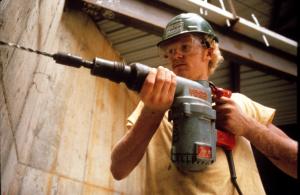
A rotary hammer drill with a vacuum dust control is a tool use to drill into stone or concrete while collecting airborne dust.
Description:
Drilling in masonry, stone or concrete with rotary hammers and hammer drills generates a large amount of dust which may contain high levels of crystalline silica and creates a hazard for everyone in the vicinity. Vacuum dust controls exist for rotary hammers and hammer drills. These controls consist of a vacuum, with a disposable filter (a high efficiency particulate air, HEPA, filter is often an option and recommended where practical), attached to a shroud that fits over and partially encloses the bit, or tool. The vacuum draws air and dust from the bit, the point of dust generation, into the shroud where it is transported through tubing and into the vacuum's bag or reservoir.

(Photo courtesy of ELCOSH)
Bosch 3/4-inch SDS-plus Rotary Hammer with Dust Collection
- Used for drilling concrete
- Cost: $290.00 (verified 11/2009)
- Maximum bit diameter (for concrete): 3/4-inch
- Revolutions per minute: 0 – 1,100
- Blows per minute: 0 – 4,400
- Impact energy: 1.8 foot pounds
- Power requirements: 120 volts, 6.1 amps
- Weight: 7.4 pounds
- Dust collection:
- Dust canister with microfilter – filter should be replaced after 15 hours of use
- Optional vacuum adapter dust canister can be used, instead of dust canister, to connect the rotary hammer to a vacuum via a 1-1/4 or 1-1/2 inch hose
- Sound pressure level: Likely to exceed 90 dBA (OSHA’s Permissible Exposure Limit for an 8-hour time-weighted average)
Bosch Airsweep™ Wet/Dry Vacuum
- Cost: $530 (verified 11/2009)
- Air flow rate: 130 cubic feet per minute
- Water lift: 100 inches
- Hose diameter: 1.38 inches (35 millimeters)
- Power requirements: 120 volts, 11 amps
- Weight: 42 pounds
- Filtration: standard set of two filters remove 99.93 percent of 3.0 micron particles, a set of two HEPA filters can be purchased for approximately $200
- Sounds pressure level: 69 dBA
Hilti TE 80-AVR/TE 70-ATC and TE 40-AVR/TE 30-AVR Combihammer
- Used for drilling and chiseling concrete, stone and masonry
- Cost: call for a quote
- Hilti VC 20U and VC 40U wet/dry vacuum cleaner
- Dust collection: used with TE DRS-S adapter and Hilti VC 20U or VC 40U wet/dry vacuum cleaner
Hilti VC 300-17X wet/dry vacuum cleaner
- Cost: $1,649 (verified 5/2018)
- Air flow rate (maximum): 314 cubic feet per minute
- Length of vacuum hose: 16 feet
- Dust capacity: 17 gallons
- Weight: 63.1 pounds
- Filter cleaning: automatic, every 7.5 seconds
- Power requirements: 120 volts, 10 amps
Metabo BHE20 IDR Electronic Rotary Hammer with Dust Extractor
- Used for drilling concrete
- Cost: call for a quote
- Maximum bit diameter (for concrete): 25/32-inch
- Revolutions per minute: 0 – 1,000
- Blows per minute: 0 – 4,900
- Impact energy: 1.2 foot pounds
- Power requirements: 120 volts, 3.8 amps
- Weight: 7.7 pounds
- Dust collection:
- Dust box with reusable pleated filter – frequency of cleaning and replacement depends on use
- Rubber-coated Metabo VibraTech (MVT) handle for vibration damping and increased comfort
- Sound pressure level: Likely to exceed 90 dBA (OSHA’s Permissible Exposure Limit for an 8-hour time-weighted average)
Risks Addressed:
Drilling concrete is a high dust activity that in the absence of controls would place workers at risk of lung disease, cancer, chronic obstructive pulmonary disease (COPD), lung scarring and silicosis with prolonged exposure. Silicosis is an incurable, sometimes fatal disease. Such disease is well documented in the Vermont granite quarries and stone cutting sheds, and in construction operations. The NIOSH-recommended exposure limit (REL) for silica is 0.05 mg/m3 as a time-weighted average concentration for up to a 10-hour workday during a 40-hour workweek. OSHA has a new construction permissible exposure limit (PEL) for respirable crystalline silica of 0.05 mg/m3 as an 8-hour time weighted average (TWA).
How Risks are Reduced:
The shrouds partially enclose the bit and have a connection for a vacuum system. When a vacuum system is connected to the shroud, air is drawn into the shroud and past the bit, capturing dust and silica near the point of dust generation. These systems capture dust and silica near the source, reducing concentrations in the worker's breathing zone and his or her exposure. For continuous use, a respiratory protection program and respirators may still be required.
In evaluations of engineering controls, Shepard et al. observed, on average, a 94 percent reduction in respirable silica during the use of a Bosch rotary hammer drill with two types of hood and two types of dust extractor. While exposures to respirable dust during use of the local exhaust ventilation systems were below the OSHA Permissible Exposure Limits (PELs), they approached or exceeded the NIOSH Recommended Exposure Limits (RELs) and ACGIH Threshold Limit Values (TLVs) for respirable silica. In spite of significant reductions in respirable silica exposure while using local exhaust ventilation, a respirator may still be necessary to reduce silica exposures to less than the REL and TLV when drilling concrete.
Effects on Productivity:
Vacuum dust control systems can have either positive or negative effects on productivity, but definitely improve the quality of the work by capturing large amounts of airborne dust, which allows a cleaner, more efficient means of drilling into concrete.
Additional Considerations:
Ventilation for construction tools is often misunderstood. There are some key concepts that can help:
- The vacuum must be located as close to the dust generation as possible to be effective. A shroud may be needed to contain the dust so the vacuum can capture it. The shroud must be kept as close to the work surface as is practical to provide adequate dust capture. The shroud should be connected to the vacuum with 2-inch, or greater, diameter tubing with a relatively smooth interior.
- The particles that can do the most damage in the lungs are small enough to penetrate the filters found on many shop vacuums. Additionally, some inexpensive shop vacuums pull the dust through the motors, which can destroy the vacuum on really dusty jobs, eliminating any initial cost savings.
- For dust containing harmful particles like silica, it is important to use as high efficiency filters as practical. The best available are called HEPA (High Efficiency Particle Air) filters because they capture 99.97% of the most penetrating particles. But HEPA filters also create a greater pressure drop and decrease in air flow rate because it is more difficult to pull air through these denser filters so capture velocity may be reduced. They also require pre-filters to extend the life of the HEPA filters, which are more expensive than other filters. Studies have shown that it may be more effective to direct the exhaust air out of the work area than to attempt to add HEPA filtration for a tool where it isn't an integral part already. HEPAs require routine cleaning or disposal of prefilters, which can cause exposures to those performing the filter maintenance.
- For operations that generate large amounts of dust, cyclonic collection units, if available, may be the best solution. Rather than require more expensive filters and bags that must be frequently changed, cyclonic units spin the particles and drop them into cheap bags that need to be replaced far less frequently because loading of the bags does not cause a pressure drop.
- Vacuum performance must be monitored on a regular basis. A vacuum with a pressure gauge allows for frequent and easy monitoring of air flow. For high dust generating tasks, dust caked on the filter may reduce flow to a level where it no longer provides adequate dust capture. Automatic and manual filter shakers, coarse pre-filters and cyclonic collections units are available with some vacuums and may help maintain the air flow rate.
Hazards Addressed:
- Masonry, Tile, Cement & Plaster
- Drill holes and install reinforcing rods and anchors
Availability
Metabo BHE20 IDR Electronic Rotary Hammer with Dust Extractor
You may be able to purchase this by searching for local distributors.
http://www.metabo.us
or contact 1-800-638-2264
Hilti TE 80-AVR/TE 70-ATC and TE 40-AVR/TE 30-AVR Combihammer and vacuums
To obtain information, visit Hilti Combihammers and Hilti VC 300-17X Vacuum
or contact 1-423-234-2111
Bosch 3/4-inch SDS-plus Rotary Hammer with Dust Collection and Bosch Airsweep
You may be able to purchase these tools from their partnered outlets.
http://www.boschtools.com
or contact 1-877-267-2499
NIOSH Workplace Solutions Sheet
The National Institute of Safety and Health (NIOSH) has published a series of “Workplace Solutions”, which are easy-to-understand recommendations from NIOSH research results. Related to this Construction Solution, please find more information on:
Reducing Hazardous Dust Exposure When Dowel Drilling in Concrete
Return on Investment
“Click to Begin", then “Load an Example” and select "Hand-Held Drill w/ Integrated Dust Collection".
