


Solution Summary: Overhead Drill Press
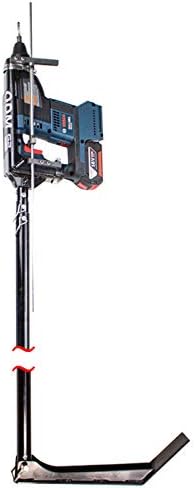
An overhead drill press is a stationary machine used for drilling holes in various materials, typically featuring a fixed stand and a vertically moving drill bit. It allows the upper arms to be held below the shoulder for a more comfortable posture during overhead drilling.
Description:
An overhead drill press in an engineering control that can reduce the risk of musculoskeletal disorders from overhead work and stressful hand and wrist activities. It is a stationary machine used for drilling holes in various materials, typically featuring a fixed stand and a vertically moving drill bit. A drill is mounted on a saddle and a telescoping vertical column positions the drill for overhead drilling. The extension and retraction of the vertical column can be manually powered by a handwheel or by hydraulic power. In some instances, a dust suppression system can be added to capture dust during drilling operations.
An overhead drill press is a stationary machine that consists of a vertical column attached to a heavy base. It has a motor-driven spindle that holds the drill bit, and it can be adjusted vertically along the column to control the drilling depth. It is designed for precision drilling tasks in which it can set the drill bit at a specific depth, and it will maintain that depth throughout the drilling process. These tools are commonly used for accurate and repetitive drilling.
An overhead drill press generally includes these features:
- Drill saddle – supports and secures the drill, and is located at the top of the drill press,
- Adjustable column – allows the drill to be raised and lowered to the desired height
- Trigger switch – activates the drill from ground level
- Stationary base – supports the drill on the ground
- Power source – supplies power to the drill
In addition, a dust suppression system for the tool may be attached to help capture dust during drilling operations. To obtain more information on equipment specifications, please visit the manufacturers' websites under 'Availability.'
The Overhead Drill Machine Generation 2 (ODM G2) (Photo courtesy of Doc's Industries Inc.)
Risks Addressed:
Overhead work can cause musculoskeletal disorders (MSDs) such as shoulder muscle strains; tendonitis, which is inflammation of the tendons; or rotator cuff tears, which is a rupture of a shoulder tendon. The overhead drill press can help reduce overhead work by allowing the upper arms to be held below the shoulder and closer to the waist.
How Risks are Reduced:
Independent studies have shown that working overhead increases the incidence of injury to the shoulder, arms, neck, and back. Reducing the vertical and/or horizontal distance that the tool is away from the body lessens the stress on worker’s shoulders and arms. An inverted drill press allows the operator to keep the arms near the body and the hands near waist level. Using an overhead drill press also eliminates the need for ladders and step stools. Most drilling tasks can be accomplished while standing on the ground. Due to the development of the column-leveling feature it is not necessary to climb a ladder to mark the drill holes. The risk of falling is decreased or eliminated with the use of an overhead drill press.
Additional Considerations:
A drill bit extension does not prevent the neck from being bent back while drilling overhead. Workers shoulder be instructed to change stressful neck positions frequently. Alternately, job rotation has been used at many worksites to minimize exposure to excessive backward bending of the neck.
Contributors:
Dan Anton, PT, PhD, ATC and Cassie Malecha, DPT – Eastern Washington University
Availability
Doc's Industries Inc.
To obtain information, visit Overhead Drill Machine – Generation 2
or contact 1-800-544-8706 info@docsindustries.com
Return on Investment
“Click to Begin", then “Load an Example” and select "Overhead Drill Press & Dust Control".
